
Nearly one in three community-dwelling older adults living with dementia or mild cognitive impairment still takes at least one central nervous system drug flagged as potentially harmful to aging brains, according to a national study led by the University at Buffalo in the Journal of the American Geriatrics Society (October 2026 issue; featured by ScienceDaily on November 25, 2026).
Although prescribing dropped over 11 years, seniors with cognitive disorders taking these sleep, anxiety, anticholinergic, or antipsychotic drugs had markedly higher rates of emergency room visits and hospitalizations—plus worse mental health-related quality of life. Because most affected patients already see an outpatient clinician regularly, routine medication reviews offer an immediate path to safer care.
Key Takeaways
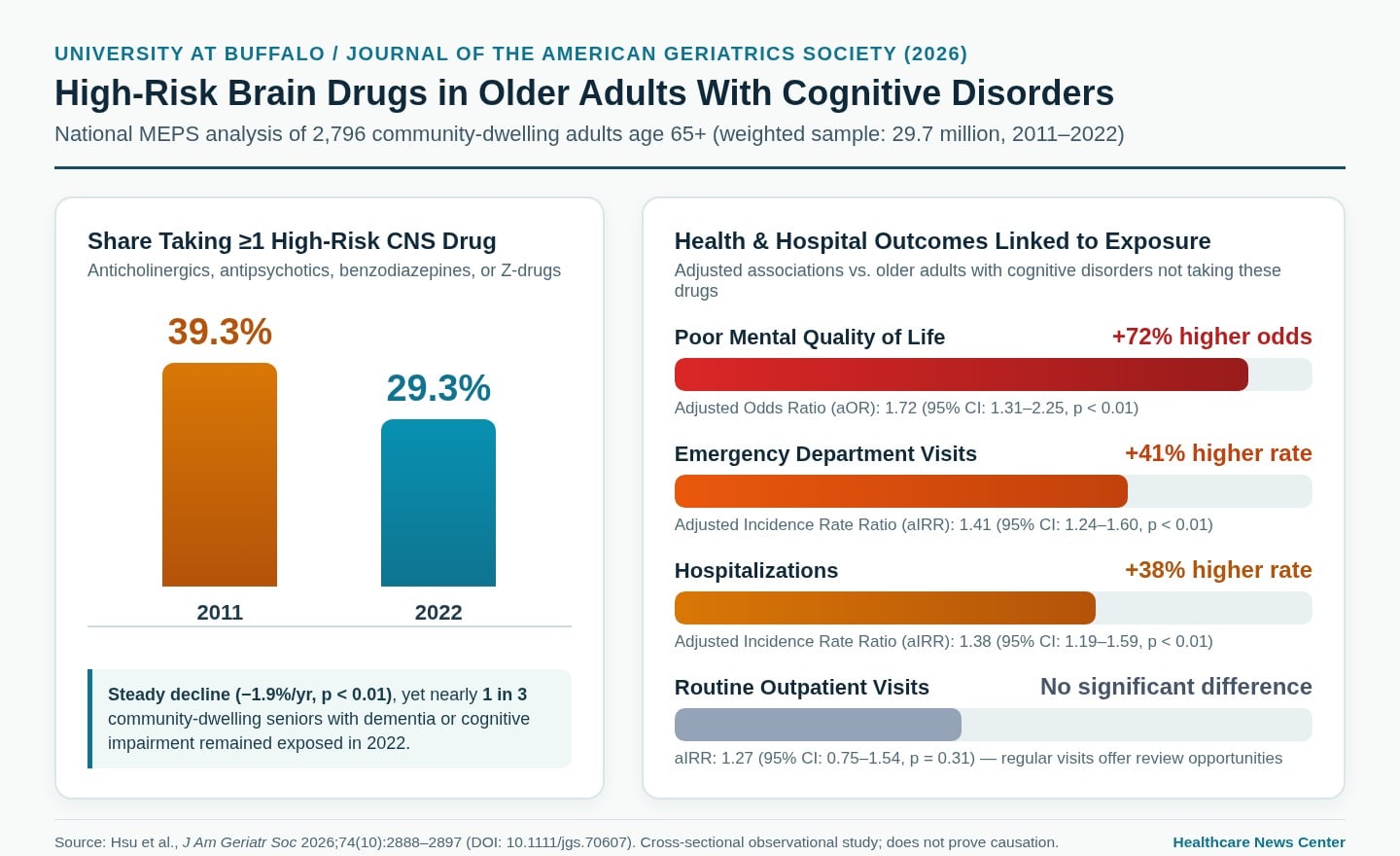
- Nearly 1 in 3 remain exposed: Across 2,796 community-dwelling adults age 65+ with cognitive disorders in 2011–2022 Medical Expenditure Panel Survey (MEPS) data (representing 29.7 million weighted older Americans), exposure fell from 39.3% in 2011 to 29.3% in 2022 (−1.9%/year, p < 0.01).
- Four high-risk classes: Researchers tracked anticholinergics, antipsychotics, benzodiazepines (such as Xanax), and Z-drug sleep aids (such as Ambien) flagged by the AGS Beers Criteria®.
- Tied to acute care: Exposure was linked to a 41% higher rate of ER visits (aIRR 1.41), a 38% higher rate of hospitalizations (aIRR 1.38), and 72% higher odds of poor mental quality of life (aOR 1.72).
- Observational evidence: Cross-sectional MEPS data show associations, not proven causation; longitudinal trials are still needed.
- Never stop abruptly: Suddenly stopping benzodiazepines, sedatives, or antipsychotics can trigger severe withdrawal, including seizures. Any reduction requires supervised deprescribing.
What Did the University at Buffalo Dementia Medication Study Find?
First author Haowen Hsu, PharmD, a postdoctoral fellow in UB’s Department of Pharmacy Practice, worked with senior authors David M. Jacobs, PharmD, PhD, Ranjit Singh, MD, Robert G. Wahler, PharmD, Collin M. Clark, PharmD, and Steven Feuerstein on the peer-reviewed analysis (JAGS, Vol. 74, Issue 10, pp. 2888–2897, published online August 4, 2026).
Focusing on independently living seniors rather than nursing home residents, the team analyzed 2,796 adults age 65+ with dementia or mild cognitive impairment across 2011–2022 MEPS data. Using inverse probability of treatment weighting and survey-weighted regression models, they compared seniors taking at least one cognitive potentially inappropriate medication (CogPIM) against peers taking none.
“This is a population with some mental issues that relate to the central nervous system. These drugs also act on the central nervous system, so they can be too much for older adults if inappropriately used,” Hsu said. Even with a 10-point drop since 2011, he emphasized the remaining gap: “We were happy to see the percentages of harm decline over that 11-year period. However, one-third of our target population is still exposed to these harmful medications, which isn’t good.”
Which Sleep, Anxiety, and Brain Medications Pose the Highest Risks?
The team drew its list from the 2023 AGS Beers Criteria®, updated after experts reviewed over 1,500 studies from 2017 to 2022. National Center for Health Statistics data cited by the AGS show over 88% of older adults take at least one prescription monthly and over 66% take three or more. When someone lives with memory loss, drugs that sedate the brain or block acetylcholine can swiftly provoke falls, delirium, or confusion.
| CogPIM Class | Common Examples | Key Risks in Dementia |
|---|---|---|
| Anticholinergics | Overactive bladder meds, diphenhydramine, tricyclic antidepressants, muscle relaxants | Worsen memory and attention; trigger delirium, constipation, and urinary retention. |
| Benzodiazepines | Alprazolam (Xanax), lorazepam, clonazepam, diazepam | Impair balance and cognition; raise fall risk; cause dependence and severe withdrawal. |
| Z-Drug Sleep Aids | Zolpidem (Ambien), eszopiclone, zaleplon | Carry fall, fracture, delirium, and daytime sedation risks similar to benzodiazepines. |
| Antipsychotics | First- and second-generation agents for agitation or psychosis | Carry an FDA boxed warning for increased mortality in dementia-related psychosis, plus stroke risk. |
“The 2023 AGS Beers Criteria® is based on the best available evidence and supports person-centered decision-making that takes into account what matters to an older person, considers both drug and non-drug approaches to care, and is focused on maximizing health while minimizing unnecessary risk,” said Donna M. Fick, PhD, GCNS-BC, FGSA, FAAN, AGSF, of the AGS Beers Criteria® Expert Panel.
Families reading our report on why younger generations are keeping their memory longer often focus on exercise or diet while overlooking everyday prescriptions—even though cumulative sedative load can mimic rapid cognitive decline.
How Are High-Risk CNS Drugs Linked to ER Visits and Hospital Stays?
After adjusting for confounding factors, CogPIM exposure showed sharp links to acute hospital use and SF-12 mental health scores:
- Emergency department visits: 41% higher adjusted rate (aIRR 1.41; 95% CI 1.24–1.60; p < 0.01).
- Hospitalizations: 38% higher adjusted rate (aIRR 1.38; 95% CI 1.19–1.59; p < 0.01).
- Poor mental quality of life: 72% higher odds (aOR 1.72; 95% CI 1.31–2.25; p < 0.01).
- No significant gap in physical QoL or clinic visits: Outpatient visits showed no significant difference (aIRR 1.27; 95% CI 0.75–1.54; p = 0.31), nor did physical HRQoL.
Because MEPS is cross-sectional, these figures show national associations rather than proven causation; patients prescribed sedatives or antipsychotics may also have more severe underlying symptoms. Longitudinal trials are needed to confirm whether reducing CogPIMs directly cuts ER visits.
The real-world stakes inspired UB’s Team Alice initiative, named for Alice Brennan, who died in 2009 after six weeks of preventable complications from a Beers Criteria® muscle relaxant. Her daughter, Mary Brennan-Taylor, partnered with UB researchers to build systemic safeguards.
Why Do Nearly 1 in 3 Older Adults With Dementia Still Receive These Prescriptions?
U.S. Census Bureau figures cited by UB show adults 65+ now outnumber children age 5 and under worldwide, and nearly 75% of older U.S. adults manage at least two chronic conditions. Multiple specialists—plus short-term sleep or agitation drugs started during a hospital stay—often stack up without one clinician reconciling the entire list.
Encouragingly, most exposed seniors already visit a clinician regularly. “It is especially important as older adults with cognitive disorders are the least able to tolerate medications that worsen memory or thinking, yet nearly one in three are still receiving them,” said senior investigator David Jacobs, PharmD, PhD. “Most of these patients have a regular source of care so these medications can be identified and addressed with their care team.” The team recommends tools like the Drug Burden Index to flag cumulative sedative load.
Why Must Patients Never Stop Benzodiazepines or Sedatives Suddenly?
Critical Safety Warning: Never Stop Brain-Acting Drugs Cold Turkey
Do not abruptly stop benzodiazepines (such as Xanax, Ativan, or Klonopin), Z-drug sleep aids (such as Ambien), or antipsychotics without medical supervision. The FDA’s benzodiazepine boxed warning cautions that physical dependence can develop within days to weeks of steady prescribed use, and abrupt discontinuation or rapid dose cuts can trigger severe withdrawal—including delirium and life-threatening seizures. Always plan a gradual taper with the prescriber.
Geriatric pharmacists champion structured deprescribing—tapering doses slowly or substituting non-drug strategies like cognitive behavioral therapy for insomnia. “A central word for patients in this age group is ‘deprescribing,’ which means, for example, removing inappropriate medications and decreasing the frequency or the dosage. In some cases, it means replacing the current medication with a milder alternative,” Hsu said. “This is why it’s so important for health care providers to work closely with community pharmacists and homecare nurses to optimize medication safety.”
How Can Seniors and Caregivers Use a Hospital-Discharge and Doctor Medication-Review Checklist?
Hospital discharges and routine checkups are prime moments to catch high-risk prescriptions. Alongside our senior medication safety tips and older-adult medication packing checklist, bring this checklist:
- 1. Bring every bottle—including OTC sleep and allergy aids: “PM” pain relievers and diphenhydramine carry heavy anticholinergic loads rarely shown on prescription printouts.
- 2. Reconcile the hospital discharge list line by line: Ask before leaving whether any sleep aid, anxiety drug, muscle relaxant, or antipsychotic started during the stay should stop now.
- 3. Ask directly about the AGS Beers Criteria®: Ask the primary doctor whether any drug is flagged for dementia or adds to cumulative sedative burden.
- 4. Request a pharmacist Comprehensive Medication Review: Community pharmacists can flag risky combinations and propose safer options to the prescriber.
- 5. Get a written tapering calendar before changing doses: Request step-down dates, withdrawal red flags, and non-drug sleep or calming options.
- 6. Update home care aides and pill organizers immediately: Clear discontinued bottles out of reach and log daytime drowsiness, dizziness, falls, or confusion.
“This is an issue that has been building for decades, but the growth of the older adult population has arrived sooner than we expected,” Hsu noted. One focused medication review can turn a hidden hazard into safer daily care.
Frequently Asked Questions
What medications are considered high-risk for older adults with dementia?
The 2026 University at Buffalo study in JAGS tracked four AGS Beers Criteria® classes: anticholinergics, antipsychotics, benzodiazepines (like Xanax), and Z-drug sleep aids (like Ambien).
Does this study prove sleep and anxiety drugs cause ER visits?
No. Cross-sectional 2011–2022 MEPS data show strong adjusted associations—41% higher ER visit rates, 38% higher hospitalization rates, and 72% higher odds of poor mental quality of life—not direct causation.
Should an older adult stop Xanax, Ambien, or an antipsychotic immediately?
No. Never abruptly stop benzodiazepines, sedatives, or antipsychotics without medical supervision. The FDA boxed warning notes sudden stopping can trigger severe withdrawal, including life-threatening seizures.
What is deprescribing, and who should lead a medication review?
Deprescribing is the supervised process of lowering doses, switching to safer or non-drug options, or gradually stopping risky drugs. Doctors, pharmacists, and home care nurses should review all prescriptions and OTC products, especially after hospital discharge.
Sources: Hsu H et al., Journal of the American Geriatrics Society (2026;74(10):2888–2897, DOI: 10.1111/jgs.70607); University at Buffalo (Sept. 16, 2026); ScienceDaily (Nov. 25, 2026); AGS 2023 Beers Criteria®; U.S. FDA Benzodiazepine Boxed Warning.