
The U.S. Food and Drug Administration approved giredestrant (Wilserdly) with everolimus on Nov. 16 for some adults with advanced breast cancer. The approval gives people whose cancer returned or worsened on certain hormone-blocking treatments another option, if their cancer meets specific criteria. One of the most important is an ESR1 mutation identified by a test the FDA has authorized.
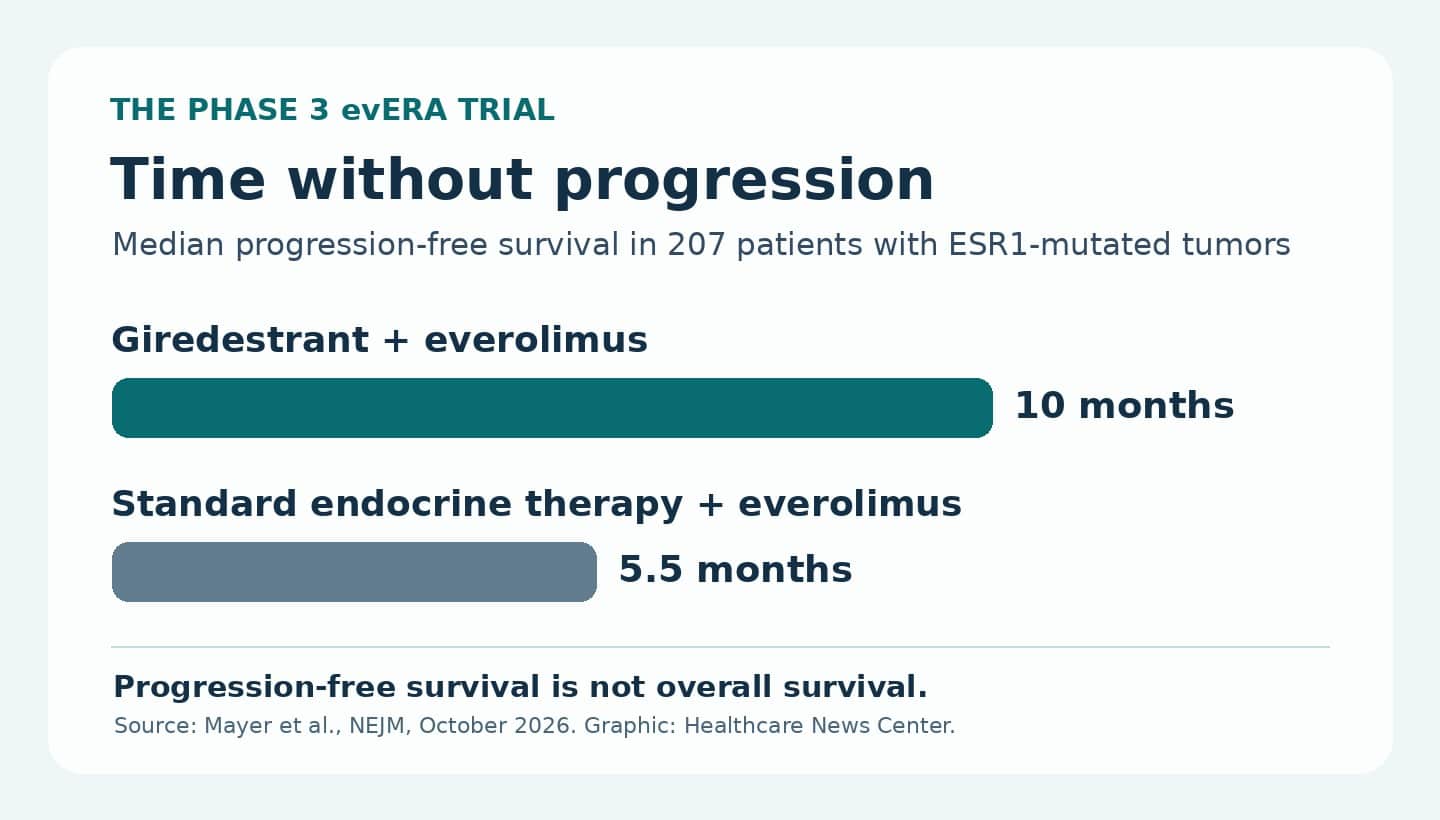
In the phase 3 trial behind the approval, the median time before progression or death was 10 months in the relevant group, compared with 5.5 months with a standard hormone therapy plus everolimus. That is a measure of time without progression or death, not proof that people lived longer overall. The FDA announcement and the November prescribing information describe who can receive it and the risks the oncology team will need to monitor.
Key Takeaways
- The approval is for adults with ER-positive, HER2-negative, ESR1-mutated locally advanced or metastatic breast cancer and a specified history of prior endocrine treatment.
- The prescribing information calls for an FDA-authorized test to look for ESR1 mutations in a blood plasma sample. An older genetic testing report may answer a different question.
- Median progression-free survival in the ESR1-mutated trial group was 10 months versus 5.5 months. There is no proven overall survival benefit from the analysis supporting this approval.
- Ask your oncology team whether ESR1 testing is relevant and whether the result would change your next treatment decision. Do not stop or switch treatment on your own.
Who qualifies for the new breast cancer combination?
The approval covers adults with locally advanced or metastatic breast cancer that is estrogen receptor-positive (ER-positive), HER2-negative and ESR1-mutated. The cancer must have returned during or after completion of adjuvant endocrine therapy (hormone-blocking treatment given after the initial treatment to reduce the chance of recurrence), or progressed on at least one endocrine-based regimen for metastatic disease. Those are two different treatment histories; you do not need to have both.
The trial population and the approved indication are not identical. Everyone in the phase 3 evERA trial had previously received a CDK4/6 inhibitor with endocrine therapy. The FDA-approved indication describes prior endocrine treatment in the two settings above and does not independently list prior CDK4/6 inhibitor use as an eligibility requirement. The distinction matters when you and your oncologist are working out how closely the study matches your situation.
The manufacturer’s Nov. 16 announcement describes the same indication. The new U.S. approval is not for every type or stage of breast cancer, and it does not mean the two-drug combination is now part of routine treatment after surgery to prevent recurrence. It is also not an approval to use giredestrant alone for this indication. If you are already taking a treatment that is controlling your cancer, the approval is not a reason to change it without a review of your individual case.
Why does an ESR1 blood test matter?
ESR1 is a gene that provides instructions for making the estrogen receptor. Some changes in ESR1 can help drive resistance to certain endocrine treatments. The label specifies testing a blood plasma sample for an ESR1 mutation using an FDA-authorized test. The prescribing information puts the selection step plainly: “Select patients for treatment based on the presence of ESR1 mutations.” This type of test is often called a liquid biopsy because it can look for fragments of DNA shed by the cancer into the bloodstream.
A liquid biopsy for a change in the cancer is not the same as inherited genetic testing for family risk. A past report about an inherited BRCA variant or a blood test that did not look for ESR1 does not answer the question about this treatment. The National Cancer Institute’s guide to tumor biomarker testing explains the difference. If you were tested before, bring the actual report and ask what was tested, when the sample was taken and whether that result is enough to make the decision now.
How much did the treatment help in the evERA trial?
The peer-reviewed evERA study randomized 373 adults. The key group for this approval included 207 people with an ESR1 mutation: 102 assigned to giredestrant plus everolimus and 105 assigned to standard endocrine therapy plus everolimus. Both arms received everolimus, so the trial compared which endocrine drug was paired with it. The results do not compare the combination with every other treatment now available.
Median progression-free survival was 10.0 months with giredestrant plus everolimus and 5.5 months with the comparison combination. The median is the point by which half the people in a group had experienced progression or died, as estimated in the study. It is not a prediction for an individual, and the difference does not mean a guarantee of 4.5 extra months of life. Overall survival results were immature at the analysis supporting approval; the study did not establish an overall survival benefit or show that the treatment cures the disease. Roche helped fund the study.
“Today’s FDA approval of giredestrant gives patients an important new therapeutic option which substantially improves disease control while also providing the convenience of an all-oral regimen,” said Dr. Erica Mayer, the trial’s principal investigator, in Dana-Farber Cancer Institute’s Nov. 16 announcement.
What should patients ask about side effects and monitoring?
Oral treatment means both drugs are taken by mouth. It does not mean the regimen is low-risk or that follow-up can be skipped. The prescribing information warns about a slow heart rate and harm to a fetus. Mouth sores, diarrhea, tiredness and changes in blood counts or other lab results were among the effects reported with the combination. Lung inflammation, called pneumonitis, was also reported. For slow heart rate, the FDA-approved patient information lists warning symptoms including dizziness, lightheadedness, fainting, shortness of breath, chest pain and tiredness.
Ask how the team would review your current medicines and supplements, what follow-up visits or labs they would schedule, and what symptoms you should report promptly. Bring a complete medication list, including anything you buy without a prescription. Ask how to contact the care team after hours. If you take a medication that can slow your heart rate or could become pregnant, ask about the relevant warnings before making any treatment decisions.
What should you bring to your next oncology visit?
Bring copies of your latest tumor or liquid-biopsy report, if available, along with a short list of your prior cancer treatments and approximately when you took them. If you do not have those records, the clinic can tell you what it can retrieve. Write down three questions: “Do my ER, HER2 and ESR1 results match the new approval?” “If we need a new test, which result would change my options?” and “How would this combination compare with the other choices for me?”
A caregiver can help take notes or track questions about prior authorization, the pharmacy, and whether someone at the clinic can help estimate what you would pay. An approval is not a guarantee of insurance coverage or of immediate local availability. If you have a scan or treatment visit coming up, bring your questions then; do not delay an agreed treatment plan while you wait for testing or coverage unless your oncology team tells you to.
Frequently Asked Questions
Is Wilserdly approved for all metastatic breast cancer?
No. The current approval is for use with everolimus in adults whose cancer is ER-positive, HER2-negative and ESR1-mutated, and whose prior endocrine treatment history meets the indication. An oncology team can review whether these details apply to you.
Is an ESR1 test the same as a hereditary breast cancer test?
No. The test the prescribing information calls for looks for an ESR1 mutation in a blood plasma sample. It is used here to help determine whether the cancer qualifies for the treatment, not to assess inherited risk in relatives.
Did the trial prove the new combination helps people live longer?
No. It showed longer progression-free survival in the ESR1-mutated group. That measures time before the cancer worsens or a person dies. Data did not establish longer overall survival.
Featured media: Public-domain archival illustration: CDC Public Health Image Library (ID 30300).