
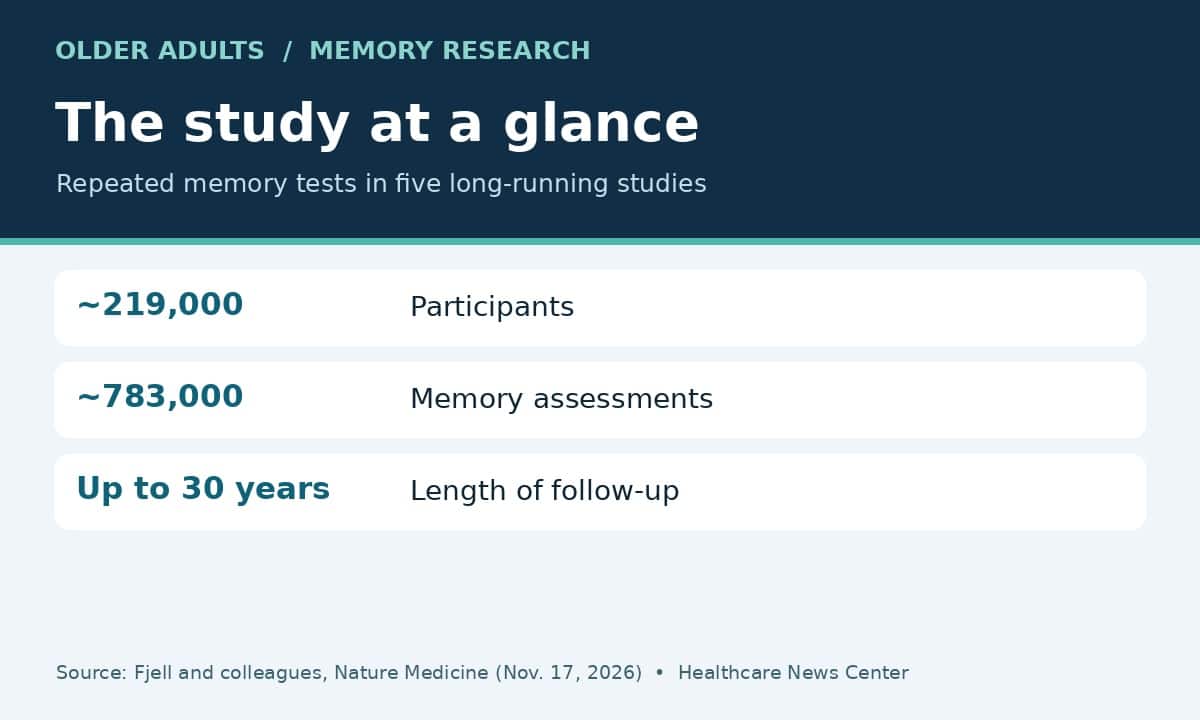
A new study suggests that people born more recently are reaching older age with better memory and losing it more slowly than earlier generations. Published Nov. 17 in Nature Medicine, the study analyzed about 783,000 memory assessments from roughly 219,000 people across five long-running studies. Some participants were followed for up to 30 years. The findings offer one explanation for why some U.S. and European studies have found a falling rate of new dementia diagnoses at a given age. They do not tell an individual whether or when they will develop dementia.
Key Takeaways
- Later-born groups performed better on memory tests at comparable ages and tended to maintain those abilities longer. The biggest improvements were among those whose scores declined fastest.
- The research is consistent with a previously reported decline of about 13% per decade in the rate of new dementia cases at a given age. That is not a 13% drop in any one person’s risk.
- Memory changes that disrupt everyday life still warrant an evaluation. A population trend is no reason to put off asking for help.
What did the researchers measure?
The team focused on episodic memory: remembering an experience, an event or information learned at a particular time. That ability helps you recall the details of a conversation or what you did yesterday. It is not the only part of thinking that can change with age. Attention, language and the ability to make a plan are different skills, and a study centered on memory scores is not a record of every change that comes with aging.
The researchers compared how groups born at different times performed at overlapping ages. The repeated tests mattered because a one-time comparison between a 60-year-old and an 80-year-old cannot distinguish aging from the different circumstances in which those two people grew up. Tracking the same participants over time, then comparing their trajectories at similar ages, gives a clearer picture of whether the rate of change also differed.
“What is new is that the ageing process itself appears to have been shifted further into the future,” lead author Anders Fjell of the University of Oslo said in the university’s research announcement, republished by Mirage News. The authors found both a higher starting level and slower decline in more recent birth cohorts. The authors also reported that the slower decline was mirrored by lower rates of clinical impairment and slower shrinkage of the hippocampus, a brain region important to memory. That does not mean everyone in the study received a brain scan or a clinical evaluation.
How can dementia rates fall while more families need care?
The study builds on an important distinction: the number of people with dementia is not the same measure as the rate at which people of a particular age develop it. Imagine two towns where the chance that an 80-year-old develops dementia in a given year is the same. If the second town has twice as many 80-year-olds, it can expect more new cases, even though an individual at that age is no more likely to develop dementia. The same logic applies when a population grows older.
The study describes the combined memory advantage as large enough to plausibly account for a previously reported 13% decline per decade in dementia incidence at a given age. That is an explanation consistent with the evidence, not a prediction that the decline will continue. Nor is it evidence that the total number of people needing care is falling. For context, the Alzheimer’s Association’s 2026 report estimates that 7.4 million Americans age 65 and older are living with Alzheimer’s dementia. Alzheimer’s is one cause of dementia; the broader term covers other causes too.
Did the study show what made the difference?
No. Participants were not randomly assigned to receive more education, different healthcare or better nutrition. The study can show when and where memory trends differed; it cannot isolate which changes in living conditions produced them or how much any one factor contributed. Fjell pointed to schooling, nutrition and access to healthcare as possible explanations in the university’s announcement, rather than as treatments proven by this study.
That distinction matters in a market crowded with products promising to keep people sharp. The study did not test a supplement, a brain-training app or a diet. Its implications are broader: it suggests that the conditions people experience much earlier in life may affect how they enter older age, while their health in adulthood may matter for how they change after that. The estimates are drawn from Western populations and should not be assumed to describe every community or country equally.
Which memory changes should prompt a conversation with a clinician?
Occasionally forgetting a name and remembering it later is different from repeatedly forgetting recent conversations, getting lost in familiar places or having trouble with bills and other tasks you once managed. The Alzheimer’s Association’s warning-sign guide gives examples of both age-related changes and symptoms worth discussing. None of these examples can diagnose dementia on its own; the important signal is a meaningful change from the person’s usual abilities, particularly when it affects daily life.
Make a short list with examples rather than relying on an impression. If bills went unpaid, note how often and whether anything else changed around that time. Note when the problems began, which medicines or supplements are in use and whether sleep, mood or hearing have changed. If the person agrees, a family member or friend who has noticed the same changes can attend the visit. Ask the clinician what else could explain the symptoms and what follow-up would make sense. Sudden confusion is different from a slow change over months and needs prompt medical attention.
What can older adults take from this research today?
The finding is encouraging for public health, but it does not replace practical care. The CDC’s healthy aging guide encourages older adults to stay physically active in ways that suit them, keep up with preventive care, manage chronic conditions and maintain social connections. Those are steps for overall health, not guarantees against dementia. For families looking for practical supports, HNC’s guide to assistive technology explains how to try or borrow everyday devices before buying them. If activity is difficult because of pain or balance concerns, ask a clinician what modifications or supports might help rather than trying to push through.
For families, one good next step is to schedule a conversation when changes interfere with familiar routines. For health planners, the study raises a different question: whether future generations will have the same opportunities for good health in childhood and adulthood. One encouraging trend does not give either group a reason to wait.
Frequently Asked Questions
Does the study mean older people no longer get dementia as often?
At comparable ages, newer groups in the study showed better memory and slower decline. The authors say that pattern could help explain past falls in dementia incidence at a given age, but it does not mean dementia is uncommon or that the trend will continue.
Did the researchers show that education or exercise prevents dementia?
No. The researchers identified differences between generations, not the effect of an individual intervention. They discuss possible contributors, but do not establish which caused the differences.
When should I get a memory change checked?
Bring it up when it is getting worse or repeatedly interferes with daily life. Give your clinician specific examples of what changed and when; seek urgent help for sudden confusion rather than waiting for a routine visit.