The U.S. Food and Drug Administration is requiring every GLP-1 diabetes and weight-loss drug sold in the country, including Ozempic, Wegovy, Mounjaro and Zepbound, to carry a new warning about a rare eye condition that can cause sudden and permanent vision loss in one eye, the agency announced on Nov. 9.
The condition, called non-arteritic anterior ischemic optic neuropathy, or NAION, happens when blood flow to the front of the optic nerve drops. The FDA said its review of clinical trials and real-world data points to a “potential increased risk” of NAION in people taking these medicines, though it stressed that NAION is rare and could not identify how the drugs might cause it.
The warning reaches millions of Americans. About 11% of U.S. adults said they were taking a GLP-1 drug to lose weight in a Gallup survey conducted in May and June 2026, up from 3% in 2024, and many more take them for type 2 diabetes.
What did the FDA announce about GLP-1 drugs and vision loss?
In a Drug Safety Communication, the FDA said it is requiring the companies that hold approvals for all GLP-1 receptor agonist (GLP-1 RA) medicines to add information about the potential risk of NAION to the “Warnings and Precautions” section of their labels. The change does not restrict who can use the drugs or for what conditions.
The FDA said its review began after a July 2024 study linked semaglutide, the active ingredient in Ozempic and Wegovy, to NAION. It then evaluated clinical trial data, animal studies, adverse event reports and observational research.
“NAION cases have been reported for all currently marketed GLP-1 RA products,” the FDA said. “FDA concluded that there is a potential increased risk of rare NAION events in patients taking GLP-1 RAs.”
Which GLP-1 medications are affected?
The requirement covers the whole class. The FDA’s list of approved GLP-1 medicines includes:
- Semaglutide: Ozempic, Wegovy and Rybelsus (Novo Nordisk)
- Tirzepatide: Mounjaro and Zepbound (Eli Lilly), which also acts on the receptor for a second hormone, GIP
- Orforglipron: Foundayo (Eli Lilly), approved in 2026
- Liraglutide: Victoza and Saxenda
- Dulaglutide: Trulicity
- Insulin combinations: Xultophy and Soliqua
- Exenatide: generic versions; the brand Byetta is no longer marketed
The labeling requirement applies to these FDA-approved products. Compounded semaglutide and tirzepatide sold by some pharmacies and telehealth companies are not FDA-approved and do not carry FDA-reviewed labeling, but they contain the same active ingredients.
What is NAION, and what are the warning signs?
NAION is caused by reduced blood flow to the optic disc, the spot where the optic nerve meets the back of the eye. It typically causes sudden, painless vision loss in one eye. There is no proven treatment to restore vision lost to NAION, according to the American Academy of Ophthalmology and the North American Neuro-Ophthalmology Society, and up to a quarter of patients may later develop it in the other eye.
The FDA said patients should contact a health care professional right away if they notice any of these symptoms:
- Sudden, painless loss of vision in one eye, often noticed on waking
- Blurred or missing areas of vision, such as blind spots or tunnel vision
- Colors that look distorted
- Reduced sharpness in the center of vision, such as blurry or hazy spots
Known risk factors for NAION include smoking, diabetes, high blood pressure, sleep apnea, anemia and kidney disease, the FDA said. Those conditions are common among GLP-1 users, which makes the link hard to untangle.
How big is the risk of vision loss on GLP-1 drugs?
The numbers are small. The FDA pooled 126 randomized clinical trials involving 134,253 patients and found 15 probable NAION cases: 10 among people taking a GLP-1 drug and five among people taking a placebo. That worked out to 6.4 cases per 100,000 person-years on a GLP-1, compared with 3.8 per 100,000 person-years for comparison groups. A person-year is one person taking a drug for one year.
A separate FDA study of adults with type 2 diabetes in its Sentinel real-world data network found no statistically significant difference in NAION risk between GLP-1 drugs and SGLT-2 inhibitors such as Jardiance, but a higher risk than with DPP-4 inhibitors such as Januvia.
For context, NAION occurs in 2.3 to 10.2 of every 100,000 adults over 50 each year in the general population, the FDA said. In 2025, the European Medicines Agency’s safety committee classified NAION as a “very rare” side effect of semaglutide, meaning it may affect up to 1 in 10,000 people taking it.
The 2024 JAMA Ophthalmology study, from a single Boston eye center, had estimated about four times the risk for semaglutide patients with type 2 diabetes, but ophthalmology groups have cautioned that its design may have overstated the risk.
What are drugmakers and doctors saying?
Novo Nordisk, which makes Ozempic and Wegovy, disputed that the drugs cause the condition. “Novo continues to believe the data do not establish a cause-and-effect relationship and we remain confident in the benefit-risk profile of our GLP-1 medicines,” Liz Skrbkova, who leads U.S. media and stakeholder relations for the company, told ABC News.
Eli Lilly, maker of Mounjaro, Zepbound and Foundayo, said in a statement reported by Reuters that the FDA’s communication “applies to all medicines with GLP-1 RA activity and does not reference any findings specific to Lilly medicines. We are carefully evaluating the update and will respond to FDA promptly.”
Dr. Manjot Gill, an ophthalmologist at Northwestern Medicine in Chicago, told NBC News the warning was appropriate but that there is little cause for immediate anxiety. “We don’t want patients to really get overly concerned and anxious and to stop these medications,” she said. “It’s fine to issue this warning more so for public awareness so that patients, should they experience any kind of change in vision, that they do actually go and seek the care of an eye provider.”
Some Wall Street analysts expect little change in prescribing. “The FDA action may temporarily increase patient and investor concern, but the rarity of NAION and substantial weight, glycemic, cardiovascular, renal, and sleep apnea benefits should preserve a favorable benefit-risk profile and limit changes to prescribing,” Citi analyst Geoff Meacham said, according to Reuters.
Should you stop taking your GLP-1 medication?
The FDA did not tell patients to stop. It advised anyone who has had NAION to talk with their health care professional about whether to continue or stop their GLP-1 medicine. For prescribers, the agency said to refer patients with suspected NAION promptly to an ophthalmologist and to consider discontinuing the drug in patients who develop it, “unless the benefits of treatment clearly outweigh the risk.”
In a joint statement approved in March 2026, the American Academy of Ophthalmology and the North American Neuro-Ophthalmology Society said stopping these drugs “could pose significant health risks for some patients,” including people with obesity, hard-to-control diabetes or heart disease. They recommend shared decision-making between patients and their care teams about whether to start, continue or stop treatment.
What questions should patients ask their doctor?
Drawing on the FDA’s guidance and the eye specialists’ statement, patients may want to ask:
- Do I have risk factors for NAION, such as sleep apnea, high blood pressure, smoking or a history of vision loss in one eye?
- Should I have an eye exam before starting or while taking this medication?
- What exactly should I do, and whom should I call, if my vision suddenly changes?
- If I have had NAION before, are the benefits of this drug still worth the possible risk for me?
Patients and clinicians can report vision problems or other side effects from GLP-1 drugs to the FDA’s MedWatch program online; paper forms are available by calling 1-800-332-1088.
Key Takeaways
- All GLP-1 drugs, including Ozempic, Wegovy, Mounjaro, Zepbound and Foundayo, must add a warning about NAION, a rare eye condition that can cause permanent vision loss, the FDA said Nov. 9.
- In 126 trials, NAION occurred at 6.4 cases per 100,000 person-years on GLP-1 drugs versus 3.8 on comparison treatments.
- Sudden, painless vision loss in one eye, blind spots or distorted colors call for a prompt call to a health care professional.
- The FDA did not tell patients to stop treatment; Novo Nordisk disputes a causal link, and Lilly is evaluating the update.
Frequently Asked Questions
Does Ozempic cause blindness?
The FDA says GLP-1 drugs such as Ozempic carry a potential increased risk of NAION, a rare condition that can cause permanent vision loss in one eye. The agency described a potential risk, not a proven cause, and Novo Nordisk says the data do not show a cause-and-effect relationship.
Which drugs get the new NAION warning?
All FDA-approved GLP-1 drugs, including Ozempic, Wegovy, Rybelsus, Mounjaro, Zepbound, Foundayo, Trulicity, Victoza, Saxenda, Xultophy, Soliqua and generic exenatide.
What are the symptoms of NAION?
Sudden, painless vision loss in one eye, often noticed on waking, plus blind spots, distorted colors or blurry central vision. The FDA says to contact a health care professional right away.
Should I stop taking my GLP-1 drug?
The FDA did not advise patients to stop. People who have had NAION should talk with their health care professional about whether to continue.
Sources: FDA Drug Safety Communication (Nov. 9, 2026); AAO and NANOS consensus statement; European Medicines Agency (2025); JAMA Ophthalmology (2024); NBC News; ABC News; Reuters via CNN; BioSpace; Ophthalmology Times; Gallup (2026).
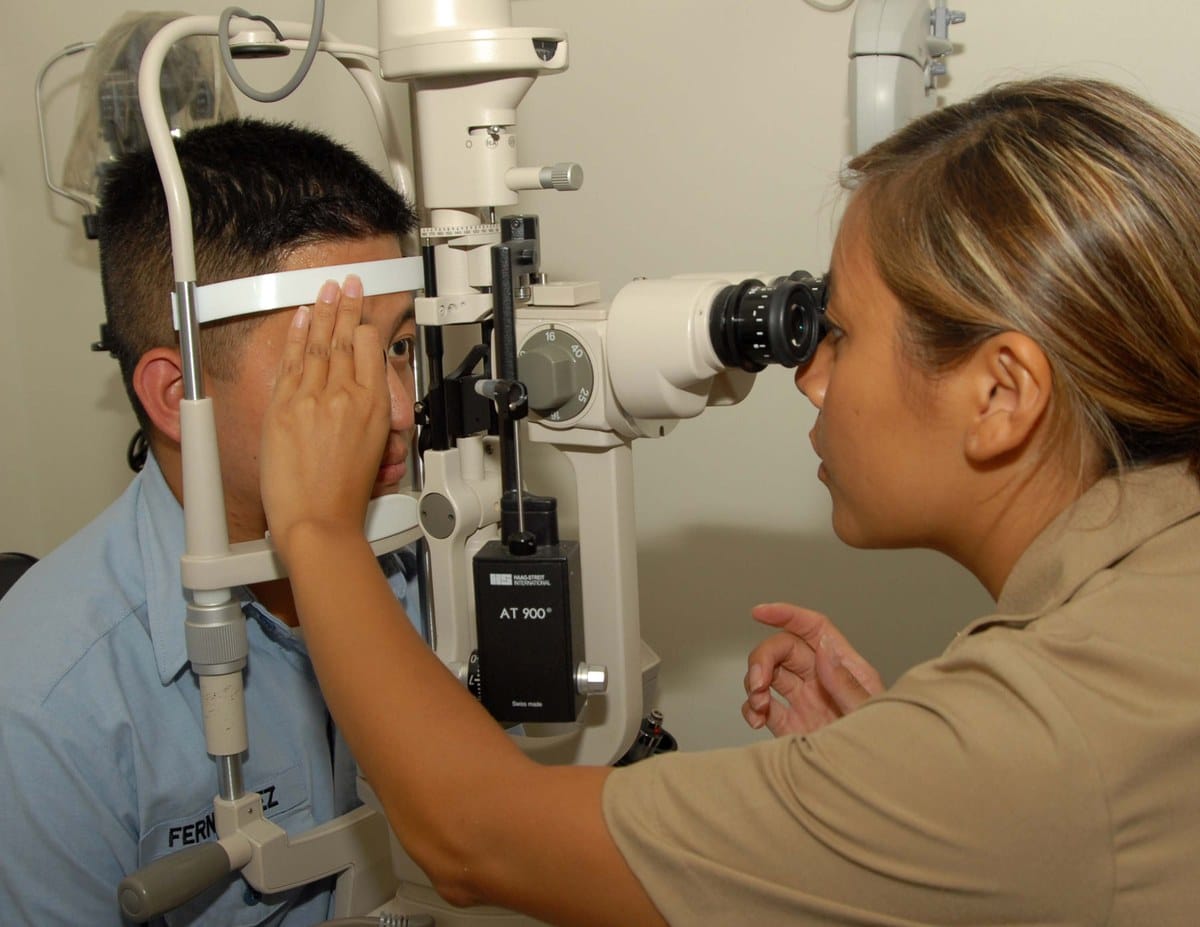
Top photo: An Air Force optometry technician receives a slit lamp eye exam at Luke Air Force Base, Arizona, April 12, 2012. U.S. Air Force photo by Staff Sgt. Darlene Seltmann, public domain, via Wikimedia Commons. Illustrative.